9.01.2004

POVERTY OR PUBLIC RELATIONS? Brewed Fresh Daily says that Cleveland's "poorest city" ranking has produced "the worst Civic Strategies post on Cleveland", in which Otis White writes:
What's the worst news a city can receive? Here's a candidate: Learning that it's now considered the poorest big city in the country. Welcome to Cleveland.
It's become apparent in the past five days that Greater Cleveland has two kinds of people:
Those who think our "poverty problem" is that too many of our neighbors are poor; and

Those who think our "poverty problem" is publicity about the fact that too many of our neighbors are poor.
Which side are you on?
POVERTY, ENTREPRENEURS AND UNIONS: Cool Cleveland is in my email box this morning, and in addition to linking to this weblog (which means a few of you came from there, thanks) it has two pieces that speak directly to this week's Cleveland buzz-topic: The city's poverty and what to do about it. The two pieces are Lee Chilcote's extended interview with Cleveland AFL-CIO leader John Ryan, and the short squib ("Can we talk?") about Indoor Comfort Services, a small venture started by laid-off HVAC worker Steve Lee.

As everyone keeps saying, the city needs more jobs. But one of the lessons the Census numbers should teach us is that employment, by itself, does not end poverty. Most of Cleveland's low-income heads-of-household are working for a living, even after the loss of all kinds of jobs in the last three years. The numbers for 1999 (the real Census) make the point clearly: With a far lower unemployment rate, at the top of the 1990s job market, Cleveland was just about as poor (relative to other cities) as we are today.

With a couple of kids to feed and house, a $7 or $8 an hour job doesn't get you out of poverty. But those are the job opportunities we've been creating for workers at the bottom end of the education/skills/experience continuum, which is a huge share of the city's adult residents. While we call these jobs "entry level", few of the employers -- in low-end service, retail, hotel or even health care -- can offer in-house upward mobility to more than a small fraction of their employees.

From the worker's point of view, there are three well-known ways out of this corner:
1) Get a better education that qualifies you for better-paid employment
2) Start your own business
3) Get a union and bargain collectively for a bigger share of the value you're helping to create.

Under the right circumstances, all of these approaches work. In a good economy with lots of job creation, they work really well. In a crappy job market like the one we're now enduring, it's hard to achieve short-term income gains with any approach, but education, entrepreneurship and (intelligent) collective bargaining can all help workers to make the best of their limited options... and get positioned for better times when they arrive.

The Mayor's "poverty summit" needs to talk about new enterprise and job creation, of course. But it also needs to discuss new City initiatives to empower Clevelanders to help themselves out of working poverty -- through education, entrepreneurship and unionization.

I've talked a lot about the first part of this triad, i.e. the strategic value of sending Cleveland to college (and computer training, and GED classes, and financial literacy classes, and anything else that enhances our people's ability to make and manage money). Today's Cool Cleveland piece about Steve Lee's new company addresses the second part, making the important point that Cleveland workers, as well as grad-school entrepreneurs, have skills that can be turned into businesses -- businesses designed to make their owners a living, not a fortune. And the interview with John Ryan introduces the often taboo third part -- the powerful role of unions in turning "a job" into "a decent living", and why so many low-income Cleveland workers are missing this opportunity.

Props to Mulready and the Hard Corps at CC for raising the right issues. And thanks for the link.

8.30.2004

NEW CLEVELAND POVERTY STATISTICS... A BIG HELPING OF SALT: As glad as I am to see Cleveland's low-income citizens getting some overdue attention from the media and public officials, I have to report that the source of Friday's big headline -- the Census Bureau's American Community Survey -- looks kind of shaky.

To be fair, the Census makes it quite clear that these annual updates are "estimates" with big error margins. But this hasn't stopped the Plain Dealer and others from leaning hard on this year's ACS "Ranking Tables" to sound the alarm about income and poverty in Cleveland.

One side of my brain says, great, it's about time! But the other side has been staring at four years of ACS Data Profiles for Cleveland -- on which the Ranking Tables are based -- and thinking, there's something strange here.

Just two examples:

1. The city's population living in households, according to the ACS estimates, was 468,389 in 2000; sank to 455,396 in 2001; jumped back up to 464,814 in 2002; and then plummeted to 424,948 last year.

2. The number of households in the city, according to the ACS estimates, was 186,435 in 2000, 184,358 in 2001, 189,171 in 202, and 186,708 in 2003.

Thus while the city supposedly lost 44,000 residents in the past three years, we supposedly gained nearly 300 households in the same period.

Do you think Cleveland lost nearly 10% of our population between 2000 and 2003? Unless we did (which would be much bigger news than being 68th rather than 65th in the "poorest cities" list), there's something badly wrong with the Census' survey techniques... wrong enough to make all the numbers dubious. If they don't have a good approximation of the number of Cleveland households, how can we rely on their estimate of those households' median income?

If anyone reading this can offer an informed explanation, I'll be overjoyed to print it. Meanwhile, though, I'm afraid we need to take the whole ACS thing with a large helping of salt.

DOES THIS MEAN CLEVELAND ISN'T REALLY ALL THAT POOR? No, it does not. As I pointed out a couple of days ago, Cleveland's place at the bottom of the big-city income pile was clearly established by the regular 2000 Census, and all the data was available over two years ago. It's laid out in excruciating detail in Cleveland Wages Pages (which I cleaned up a little over the weekend, moving the Yahoo ad boxes out of the way).

We didn't learn anything new about Cleveland's poverty last Friday. The media has just gotten around to telling everyone about it.

So... the Mayor has responded by calling a "working summit" on poverty this Friday morning to...
work in concert with the Center for Community Solutions to identify the best practices in lifting Cleveland out of poverty. The working group will develop and implement a comprehensive strategy to attack poverty in the City of Cleveland.
This is a discussion the city needs, and if the Mayor is finally ready to kick it off, more power to her.

But let's hope it doesn't stay in one meeting room. Let's hope it spills out into next year's City election, forcing candidates in 2005 to debate the one issue that really matters in Cleveland: Why are so many of us so poor, and what can we do as a community to enable our citizens to make more money?

Some of my answers next time. Meanwhile, take a look at MaryBeth Matthews on sending Cleveland to college.

8.27.2004

THE BIG PICTURE: Meanwhile, MaxSpeak lists some things that the new American Community Survey tells us about the national economy...
THE PLAIN DEALER NOTICES POVERTY: In big black type, top of the front page this morning:

Cleveland No. 1 in big-city poverty

The story concerns the U.S. Census' newly released American Community Survey for 2003, an annual mini-census which attempts to update the decennial census data by polling a large sample of households throughout the U.S. About 2,400 Cuyahoga County households were interviewed for the 2003 data, presumably including a large number in the city, which has about 35% of the county's population. This is a substantial professional polling effort, but it's a lot less comprehensive than the regular Census, so its results -- especially for the smaller samples like the city -- need to be taken with larger amounts of salt. But within its comfortable error margins, the ACS is probably the best current data available.

News coverage of the ACS (nationally as well as locally) has focussed on its "Ranking Tables" comparing states, counties and "places", i.e. cities, on various topics. The "Places" rankings compare sixty-eight big cities including Cleveland.

What the PD noticed this morning is that Cleveland showed up dead worst in the following categories:
Median household income -- $22,978 (68th of 68)
Median family income -- $28,108 (68th of 68)
Percent of people living below poverty level -- 31.3% (1st of 68)
Percent of children below poverty level -- 46.9% (1st of 68)
Well. Apparently this is a surprise to the PD editors. Maybe that's because, with all the paper's huffing and puffing about the Quiet Crisis, they never got around to looking at the city's income rankings in the real Census, when the 2000 Decennial Census data came out two years ago. Since the PD and other media didn't report it, most local readers wouldn't have known that Cleveland showed up at the bottom of those same rankings five years ago -- before 9/11, before the recession and the jobless recovery, when we were still basking in the Clinton boom and the Voinovich/White "renaissance" and "neighborhood rebirth" era, and downtown offices were still hiring temp workers, and the IT sector was growing, and thousands of single mothers had supposedly moved from welfare to employment. Back when the Crisis was, you know, Quiet.

In fact, I was so appalled by the lack of coverage that I put up a website called "Cleveland Wages Pages". Here are the opening words on the index page, circa September 2002:
Here's a headline you haven't seen in the Plain Dealer:

Cleveland is poorest of top 50 U.S. cities

But it's true -- or at least it's what the new U.S. Census tells us. Look a little further down this page for the details, but here's the nub of it: The average personal income of all Cleveland residents in 1999 was the lowest among the nation's fifty largest municipalities.

That makes us literally the poorest (to be precise, the lowest-income) big-city population in the nation.
Well, now we have seen the headline in the Plain Dealer -- big, scary and above the fold on Page 1. It's about time. Now what will that headline lead to -- other than complaints from some quarters about the PD's negativity?

More later.

8.25.2004

CLEVELAND SCHOOLS' PROFICIENCY SCORES STUMBLE: As the Plain Dealer says this morning, the complete 2003-04 school district report cards won't be on line at the Ohio Department of Education site until next Tuesday. However, the data is available at http://dnet01.ode.state.oh.us/DistrictRatings/, which makes the PD's failure to report on it a little mysterious.

Here are some key 2004 numbers for the Cleveland Municipal School District that haven't yet appeared in the newspaper:
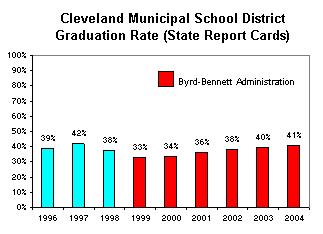
High school graduation rate: 40.8%, up just 1.3% from 2003 but topping 40% for the first time since 1997. (See chart below)

Fourth grade proficiency test (percent of students scoring at or above "proficient"): The average of all five tests was 53.5%, down 4% from last year. The declines were in citizenship (-5%), reading (-4%) and writing (-4%). Science was unchanged; math improved by 4%.

Sixth grade proficiency tests: The average pass rate for all five tests was 43.8%, down 5% from last year. Science, reading and citizenship all showed big declines (-13%, -12%, and -10% respectively). Writing was up 3% and math was up 5%.

Tenth grade proficiency tests (percent of tenth graders at or above ninth-grade prociency levels): The overall average was 77.8%, up 3% from last year. All five tests showed modestly higher pass rates than in 2003, with the biggest improvement in math, up 4%.
For those who are keeping track, here are the "official" CMSD graduation rates for the last nine years:

8.21.2004

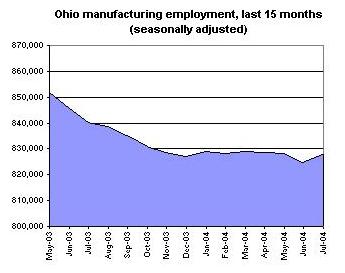
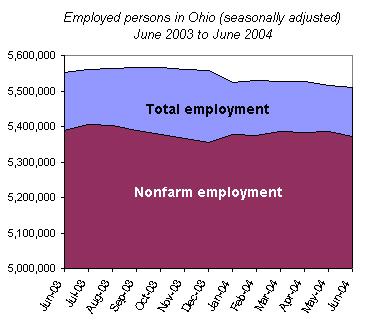
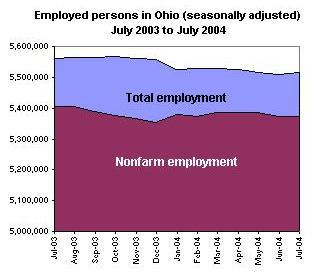
OHIO'S RECOVERY CONTINUES, JULY EDITION: The Bureau of Labor Statistics posted its July state employment numbers yesterday. Let's go to the chart:


Alison Grant's coverage in the PD is headlined "...manufacturers add jobs" and quotes Jo Ann Davidson calling the manufacturing count "even more encouraging", so here's an extra chart to put it in context:


8.20.2004

LOCAL FORECLOSURES UP 25% SINCE 2001, SHERIFF SALES MORE THAN DOUBLE: Policy Matters Ohio has a major new county-by-county study of Ohio home foreclosures available on its website. It's based on a statewide survey of county sheriffs and it's full of bad news.

The bad news for Cuyahoga County:
Home foreclosures in 2003: 8,686, up 25% from the number in 2001.

Sheriff sales in 2003: 4,421, up 111% (!) since 2001.
One out of every sixty-six homes in Cuyahoga County was the subject of a foreclosure last year.

8.19.2004

IF I LIVED IN COLUMBUS... Columbus, like Cleveland, is served by both a private investor-owned electric company (Columbus Southern, a subsidiary of American Electric Power) and a municipal electric system.

If I lived in Columbus, my new electric bill for 615 kilowatt-hours would be:
$51.90 if it came from the city's Division of Electricity, or

between $53 and $54 if it came from Columbus Southern.
In either case, my electric bill would be at least $25 cheaper than the one I just got from CPP.

Why can both the private and public power companies in Columbus sell exactly the same service as CPP (and CEI), subject to the same Ohio laws and regulation, for 30% to 35% less?
OUCH! CLEVELAND PUBLIC POWER MAKES MORE HISTORY: Our Public Power bill -- for service in July -- showed up in the mail yesterday. The charge for 615 kilowatt-hours was $79.16, or 12.9 cents per kwh. Not only is this the highest rate ever charged by CPP... it's probably the highest price charged for home electric service by any utility, private or municipal, in the whole state of Ohio this month!

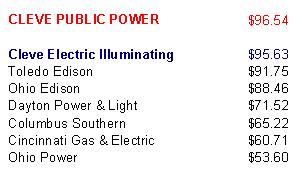
According to the new Ohio Utility Rate Survey for June, CEI's Summer bill for 750 kwh is $95.63. CPP's bill for that same 750 kwh used in July would be $96.54.

Here's how CPP's July 750-kwh charge compares to the seven major investor-owned electric utilities in Ohio, according to the Rate Survey:


I can't believe this hasn't become a news story. Thirty thousand households switched over to CPP in the '90s on the promise of lower bills, and now they (and the fifty thousand of us who were already with the system) are getting gouged as badly as any ratepayers in the country... and it isn't news? Why aren't Tom Meyer and Carl Monday chasing down Public Power Commissioner Jim Majer, or his boss Utilities Director Julius Ciaccia -- or his boss, Mayor Campbell -- to demand an explanation?

8.12.2004

STUDY SAYS EDUCATION LEVEL DRIVES CITY GROWTH

"The Rise of the Skilled City", Edward L. Glaeser and Albert Saiz, 2003 (abstract):
For more than a century, educated cities have grown more quickly than comparable cities with less human capital. This fact survives a battery of other control variables, metropolitan area fixed effects, and tests for reverse causality. We also find that skilled cities are growing because they are becoming more economically productive (relative to less skilled cities), not because these cities are becoming more attractive places to live. Most surprisingly, we find evidence suggesting that the skills-city growth connection occurs mainly in declining areas and occurs in large part because skilled cities are better at adapting to economic shocks. As in Schultz (1964), skills appear to permit adaptation.
The whole paper (68 pages, pdf format, lots of graphs and regressions) can be downloaded from the Philadelphia Federal Reserve site here. For those with shorter attention spans or slower connections, here's a one-page digest/review (with related research by Glaeser) from the National Bureau of Economic Research. First paragraph:
Possessing or attracting a large population of skilled, educated workers appears to be the key factor in determining whether declining urban areas -- such as the infamous "Rustbelt" manufacturing centers of the 1980s -- chart a path back to prosperity or remain relatively stagnant. In the Rise of the Skilled City (NBER Working Paper No. 10191), NBER researchers Edward Glaeser and Albert Saiz conclude that the percentage of workers with college degrees is a "powerful predictor of urban growth."
Send Cleveland to college!
HIGH TECH AND HUMAN CAPITAL: From an article by Boston Federal Reserve economist Pingkang David Yu, by way of Don Iannone (thanks, Chris Seper!):
But what exactly is a high-tech industry? And how can we determine how high-tech a city or metro area is? In the late 1970s, researchers often used the share of scientists or engineers to classify an industry as high-tech, but recent studies have tended to focus on factors such as whether the industry produces high-tech products (like electronics and computers) or uses high-tech inputs (for example,spends a lot of money on research and development).

A growing body of research suggests that human capital -- skilled labor -- may be a better gauge and a more important driver of economic development. Growth theorists have stressed the importance of human capital to productivity and income growth for the economy as a whole. Other researchers have tried to assess the role of skilled labor in regional employment growth. In The Rise of the Skilled City, for example, Edward Glaeser and Albert Saiz suggest that metro areas with educated workers grow more quickly than comparable cities with less human capital, for the most part because they are more economically productive and better able to adapt to economic change.
Download the article here in pdf format.

In the last census, 11% of working age adults in the city of Cleveland had four-year college degrees -- tying us with Detroit for last place among the fifty biggest U.S. cities. And 31% of Cleveland adults lacked even high school degrees.

What are our chances?

8.06.2004

AND SPEAKING OF THE CLEVELAND SCHOOLS' GRADUATION RATE...

MaryBeth has something to say.

8.05.2004

CLEVELAND SCHOOL BOARD PROPOSES 35% PROPERTY TAX HIKE.

No press release from the Mayor.

No press release from the School Board or CEO.

It's not like they're hiding from reporters. Apparently the Mayor held a press event to support the proposed levy today, judging from this Channel 3 clip.

They just don't seem to want to discuss this subject in writing... like the budget cuts and layoffs, which are still non-events on both the City and School District web sites. (To be completely fair, there's now a release posted on the School District site about "District transportation changes" which begins: "Due to the Cleveland Municipal School District’s financial crisis, a number of significant changes have been made in transportation services offered by the District." But the words "budget" and "cut" do not appear in it.)

I'm going to vote for this levy -- probably -- but it sure would be easier if the public officials in charge started making a visible effort at public transparency. And please, please, please, Madam CEO, stop talking about "improvements in graduation rates". At some point it's going to get embarrassing.

8.04.2004

"WE THE MEDIA":

From Lessig...
The full text of Dan Gillmor’s book “We the Media,” about blogs and other things, is now online.

8.03.2004

GAMES AND GAMES... The big event of the last week leads one to ponder the meaning of being a Democratic political leader in Cleveland. No, I don't mean the convention. I mean the International Children's Games.

For the past eight months Jane Campbell has invested a lot of her resources -- and the City's -- to make the Games look good. She personally took on a large share of the fundraising responsibility. She had Cabinet members spending half their time overseeing the details of security and technology. They called in every imaginable favor to get business resources and volunteers. Some City utility employees worked full-time on the Games for months. (Disclosure: I was part of the committee for the "Cyber Scene" game area -- at a Cabinet member's request -- and I met some very nice people doing it.)

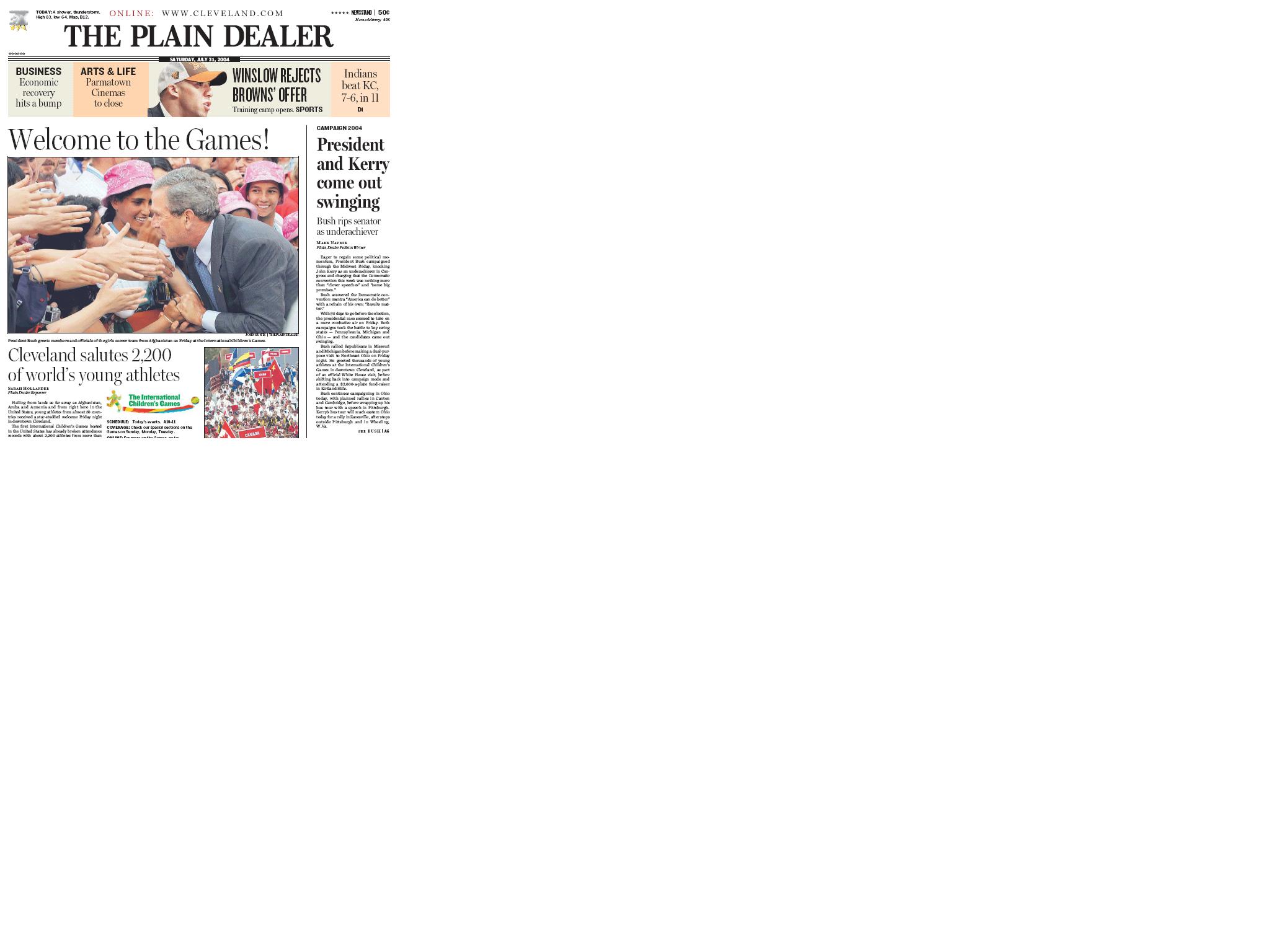
Campbell did all this while other Democratic leaders and footsoldiers, in Cleveland and throughout the country, were obsessing about nothing but the national election. As her reward, she got to wake up Saturday morning to see George Bush's smiling face on page 1 of Alex Machaskee's newspaper, opening her Games (and Machaskee's) in the biggest media market of the nation's most crucial swing state, on the day the Bush campaign most wanted him there to distract voters from Kerry's big convention moment.

How do you think the Kerry campaign liked that?

I've written before that Campbell's best chance for re-election is to play a recognized role (like helping create a massive Cleveland turnout) in a Kerry victory in Ohio that puts him in the White House.

If I'm right, the Mayor appears to have some serious ground to make up in the next three months. Far from helping, the Children's Games -- and the grownup political gamesmanship around them -- probably cost her a few steps.

Of course, what's really important is that the kids had fun. But I hope the Mayor had fun, too, because she paid for it.
NEIGHBORHOOD BLOGGING... at Digital Vision.

8.02.2004

"SAVE WITH PUBLIC POWER?" NOT ANY MORE...

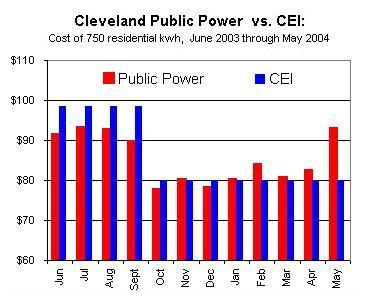
Back in April I reported that Cleveland Public Power rates had actually exceeded CEI/First Energy rates for the first time in February. This should have been big news in Cleveland, because CPP still routinely claims that its customers have lower bills -- and because there's a whole chapter of recent Cleveland history devoted to the struggle to preserve "Muny Light" as a low-cost alternative to CEI.

My earlier comparison was based on CEI charges for a residential customer using 750 kilowatt-hours a month, according to the PUCO's monthly Utility Rate Surveys. At that time the PUCO surveys showed CEI's Winter bill for 750 kwh at $82.64. But that's changed; the PUCO now says the amount was really $80.08. Using that corrected figure, it seems that CPP charged more than CEI not just in February, but in November, January, March, April and May as well.


(Note: As you look at this graph, remember that CEI charges higher Summer rates for June, July, August and September. CPP has higher Summer rates in all four of those months plus May.)

Over the whole past year, the average CPP kilowatt hour for a 750-kwh household cost about 11.4 cents, compared to 11.5 cents charged by CEI. There was still a total "public power savings" for the whole year -- the princely sum of $10. But that "saving" doesn't factor in the "WPS" aggregation discount that the City provides to CEI households in Cleveland. Include that discount in the equation, and CPP's total year-round cost was higher than CEI's for Cleveland residents..

Of course, both local utilities are far more expensive than other municipal electric systems in Northeast Ohio -- not to mention the private utilities that profitably serve homes in Columbus, Dayton, Cincinnati, and the rest of southern Ohio for 7 to 9 cents a kilowatt-hour.

So when do you suppose this is going to become an issue for the Mayor and City Council?

7.30.2004

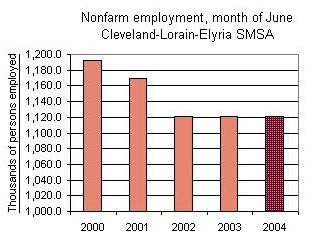
CLEVELAND AREA JOBS... NO MOTION: The U.S. Bureau of Labor Statistics posted its new metropolitan job numbers Wednesday.

Their June 2004 count of employment on nonfarm payrolls in the Cleveland/Lorain/Elyria metro area is virtually identical to June 2003... which was virtually identical to June 2002.


Which is to say, we're still at the bottom of a three-year trough... and not moving.

7.24.2004

"HELLO, MY NAME IS SATAN": Good news, MaryBeth is back.
FEELING SAFER NOW? I don't spend much time on national politics here unless there's a direct Cleveland angle, but in this case I'll make an exception.

Here's Chapter 8 of the 9/11 Commission Report, entitled "The System Was Blinking Red".

The Kerry campaign should be passing out copies of this chapter as a talking book.

Yeah, yeah, I know, Clinton screwed up too. But Clinton isn't on the ballot this Fall. Bush and Cheney (and Rice, and Rumsfeld) are.

So just read it. Thank you.

(courtesy of Atrios)

7.23.2004

IF YOU READ THAT, PLEASE READ THIS: A couple of days ago I wrote at length about City Council's focus on real estate, rather than human capital, in its list of strategic neighborhood investments. I leaned pretty heavily on an example from my own immediate neighborhood. While I didn't name the Council Member involved, anyone familiar with Cleveland politics could see that I was talking about Councilwoman Merle Gordon of Ward 15, who also happens to chair the Community and Economic Development Committee.

Up to a hundred people read this weblog weekly, and I don't know who most of you are. So it occurs to me that I shouldn't leave you with the impression that Councilwoman Gordon is especially obsessed with real estate projects, or oblivious to human needs in her ward.

I don't really have any idea of Gordon's overall philosophy of economic and community development. I do know, though, that she used ward allocation money to help get Art House on Denison Avenue started, for which she took a lot of grief from her opponent in the last election. And that she's a supporter of Brookside Center, the hunger center I mentioned in the piece, which is in the process of starting up a small computer center. And that she's one of three Council Members who help manage the Adelphia/City Council Neighborhood Technology Fund, which is the main source of local grant support for community technology centers throughout the city.

So if anything, Merle Gordon might be more attuned than the average Councilman to the human investment paradigm I'd like the City to adopt. I don't know. I haven't asked her. I should. I will.

But please understand, I'm not saying that that City Council (or any specific Council Member) is uniquely backward in their thinking about community economic development. On the contrary -- I think Council's list of priorities shows that it's right in the mainstream, in close synch with the CDC community and its supporters in the policy and funding worlds. I'll go further, and say I think Councilmen pretty well reflect the priorities of the most active civic leaders in their wards.

We're all operating on 1980s community development assumptions that have little to do with the economy of the 21st century, or our neighbors' place in that economy. And we all need to start examining those assumptions.

7.22.2004

7.21.2004

CITY COUNCIL'S PROJECT LIST: WHERE ARE THE PEOPLE? The PD reported last Tuesday that Cleveland City Council and Mayor Campbell have agreed to a bond issue to raise $20 million for small economic development projects. The City will use repayments from its portfolio of old UDAG loans to pay off the new bonds, which means the Mayor and Council are borrowing against future income to create a pot of strategic ready cash.

Council's list of 21 priority projects, one for each ward, is here (pdf file). The PD's predictable problem with The List is the absence of downtown projects (apparently Councilman Cimperman's priority, live-work housing conversion on East 30th, isn't "downtown" enough). It seems that the Campbell Administration shared this concern, because a fifth of the pot is now targeted for downtown, whatever that means. The remaining $16 million -- $800,000 per ward, more or less -- is for the rest of us.

The history of this deal, you'll remember, goes back to the Great Convention Center Negotiation of 2003, when Frank Jackson demanded money for strategic neighborhood investments as the price of City Council's support for any deal. Campbell agreed to the concept and pointed to the availability of her "Core City Fund", another bond-financed pot underwritten by revenue from the City's Chagrin Highlands development deals. The Convention Center process fizzled, but Jackson made clear he would keep pushing for his agenda, and now it looks like he'll be able to deliver something -- committed cash, if not shovels in the ground -- in time for Council Members' re-election campaigns in 2005.

In principle, I strongly support Jackson's approach. Heck, I support it in practice -- it's sure better than nothing, which is the amount of new cash that Councilmen and their constituents could expect for local priorities if they'd left it up to the other side of City Hall.

But looking at Council's list of "Economic Development Priorities", a person has to ask: Are these the best economic development initiatives they can devise for $800,000 per ward in unencumbered cash?

The striking thing about Council's project list is that it's all about real estate... vacant buildings, land assembly, retail area improvements, a couple of parks. This is standard-issue Cleveland "community development strategy"; renovate a building, clean up some land, put in new curbs and lights, build some new houses, and somehow safety and prosperity will follow for your residents. It ain't necessarily so.

Take, for example, the City Council ward where I live.

The "priority economic development project" for my ward is a $1.8 million renovation of an old Masonic Hall on West 25th, two blocks from my house. The Councilwoman wants to subsidize the conversion of the first floor into four retail spaces, and the two upper floors to "residential, possibly live work space". The building sits between a McDonald's and the local hunger center (which is expanding); it's across the street from an Aldi's, routinely crowded with poor people looking for off-brand groceries. The neighborhood strip plaza up the street, the Councilman's pride when it was built ten years ago, now almost always includes beggars in the shopping experience.

The two adjacent census tracts (1055 and 1056.2) were home to 1,113 families in 1999, the last census year. 24% were living below the Federal poverty line A quarter of the families had annual incomes of less than $15,000. 45% had incomes below $25,000. Of local residents "in the labor force", 11% were unemployed. (This was in 1999, when the official citywide unemployment rate was about 9% -- it's now hovering around 13%.) A third of adult residents lacked a high school diploma or GED certificate, and only 8% had four-year college degrees.

Why would the Councilwoman representing these families make the reuse of an old Masonic Hall -- a little retail space, a few live-work apartments -- her "economic development priority"? What opportunities will it bring them? Maybe a handful of $8 retail jobs, or a chance to clean the halls. How is this a "strategic investment" for the community?

Instead of one more building, why not consider an $800,000 strategic investment in the people themselves?

For example:

1) For $800,000, we could buy the neighborhood a really terrific community technology training center for four or five years. Like Tri-C's Rainbow Terrace Family Learning Center, which is not only teaching low-income parents computer skills but getting them through their GED exams and into college... or the Cleveland Housing Network's "Bringing IT Home", which combines computer training with financial literacy, getting hundreds of adults' credit repaired so they can get a small loan to buy a computer... or Esperanza's very low-budget program, which trained over a hundred low-income adults last year in MS Office applications and job search skills, and helped most of them get into jobs or college.

A fully funded, $200,000-a-year neighborhood center could reasonably expect to connect several hundred underemployed, undereducated neighbors with this kind of training every year. In four years that could add up to a thousand people on the path to better educations and incomes. Wouldn't that be a more "strategic" investment for the community than one more rehabbed building?

2) Or we could invest $800,000 in helping ward residents with high school diplomas to go to college. Let's say we formed a partnership with the Cleveland Scholarship Program and Tri-C, spent $100,000 to put a full-time college recruiter/counselor in the Councilwoman's ward office for two years, and used the rest of the money for scholarships (or to subsidize and guarantee loans) to help neighbors get Tri-C associate degrees? Suppose we pulled Metrohealth (by far our biggest local employer) into the partnership, and targeted those scholarships and loans to health industry job credentials? Don't you think that would be more productive for local employment than four retail spaces and a few apartments?

I'm picking on my Councilwoman here, which isn't fair; I'm sure she was asked to choose a project for The List, and simply chose one she thought made sense. City Hall isn't used to thinking of investment in human beings as neighborhood development. That's a natural reflection of the city's CDC paradigm, which has evolved over twenty-five years of struggling for public/private reinvestment in neighborhood housing, retail space and infrastructure. Council's "Economic Development Priorities" adhere faithfully and honestly to that paradigm.

But by now it should be clear that the CDC paradigm -- at least its Cleveland version -- is not really about economic development. Buildings don't earn income or create wealth, people do. In the 21st century, we mostly do it with intellectual assets -- education, information, skills. People who are uneducated, disconnected from the relevant technology, and stuck in low-value-added occupations will not sustain healthy, prosperous neighborhoods, no matter how many "projects" happen around them.

Cleveland's neighborhoods need a new "development" paradigm for the new economy, and we need it now.


A wide-open public discussion of The List -- our Council Members' declared priorities for strategic economic investments in their wards -- would be an excellent step in that direction.
7.20.2004

PRIORITIES: Just when you think things can't get any stranger... from today's PD story about Cleveland School District administrator layoffs:
One employee who may get a layoff notice from Barbara Byrd-Bennett is her son-in-law, Edmunson Suggs, a liaison between the district and the Cavaliers and Browns teams.
Huh?

Update for Wednesday, July 21... from this morning's PD, "Budget cuts affect struggling schools":
...Byrd-Bennett's son-in-law, Edmenson Suggs, will be laid off in the next round. He is paid $73,165 for his job as a liaison between the school district and professional sports teams.

Ruda said his position has not been cut yet because everyone in the office of extracurriculars is needed to help with the upcoming fall sports season.

7.13.2004

"FREE PUBLIC WIRELESS" AT CWRU? Also from today's One Cleveland weblog:
Finally, wireless aficionados, Case Western Reserve University has big news on the free public wireless front. Steven Organiscak, Case's project manager for integrated technology planning, announced yesterday that Case has completed its 802.11g forklift. Yup, 1315 (count 'em) 802.11g free public wireless services available at 54 Mb/sec along with VPN access for Case staff, students, and faculty for tunnel access to the University. It's the biggest public wireless deployment of 802.11g in the nation.
I'm a little bit confused. As far as I can tell, almost all of these access points are inside university buildings, to be used by people who are there on Case business (including "guests"). There's outside access in the academic quadrangle, but this is also on University property where, presumably, random members of the public aren't encouraged to hang out with their laptops. The only CWRU access point that actually serves a public place is the one at Wade Oval.

Am I wrong about this? Can I walk down Euclid, Ford or Wade Park and connect to the Case guest network? Or is "public" just another word (like, say, "community") that means whatever I want it to mean?
MORE ON THE NATIONAL WIRELESS SUMMIT: Details are now posted on the website of the 2004 National Summit for Community Wireless Networks, August 20-22 in Champaign-Urbana.
The Summit, expected to be the largest community wireless networking event to date, will support the work of community wireless networks by facilitating the critical alliance of technologists and policy experts and by encouraging participants to discuss the great variety of challenges and opportunities facing their initiatives:

* Do community wireless networks really serve the populations they ought to reach, and if not, what needs to be done?
* What is the future of the FCC's unlicensed spectrum policies that enable the innovations that drive community wireless technologies?
* Can dozens of independently-operating community wireless initiatives join together to create a positive future for the movement?
There's now a list of participating groups, an agenda and registration page. Participants include Seattle Wireless, NYC Wireless, Austin Wireless City Project, a bunch of national organizations including EFF and the Association for Community Networking, as well as the Center for Neighborhood Technology and other Chicago folks. So I guess it's really national, and it's certainly going to be interesting.

Today's One Cleveland blog says they're involved, too, but they're not on the list of participants or speakers. An oversight, I hope.

So... my Cleveland carpool now seems to include Steve Goldberg, George Nemeth, and Steve Finegold of Tremont WiFi. Anyone else?

7.09.2004

SO YOU WANT TO TALK ABOUT A WIRED CITY? Check out the capital of Iceland.
Reykjavik, Iceland, likes to set records. In April 2003, the world's first public hydrogen fuel station opened. The world's largest geothermal system heats houses and even streets. Now Reykjavik is trying to become the first city in the world that delivers fiber to every home.

Since installing a fiber-optic backbone network four years ago, Reykjavik Energy, a city-owned utility, has connected 500 electricity substations with fiber and has begun running fiber from substations to homes. After a 100-home trial that began last year, the utility's goal is to connect 4,000 homes this year, 15,000 homes in 2005, and all 65,000 Reykjavik homes within five years...

During the trial last year, Reykjavik Energy provided 100M bit/sec connections by installing a customer premises switch from Swedish company PacketFront in each participating home. The wall-mounted switch connects to the fiber on one end and provides eight Ethernet ports on the other end. Four of the ports are used for an IP set-top box, two for Internet access and two for "general purpose."...

Reykjavik Energy provides the infrastructure, while partners deliver the services. "Our network is open to all service providers. The customer activates each service and pays each service provider directly," Finnsson says. "That's the beauty of it." Once a customer activates any service, the utility charges a fixed monthly fee regardless of the number of services used. The utility also receives revenue-sharing from service providers.
Hmmm. Adelphia Cable's current Cleveland franchise ends in two years... assuming Adelphia survives that long, of course. And we have a public power company. And a city water system. And One Cleveland. And a city election just around the corner.

Maybe some planets are lining up...

6.30.2004

I just added TIM RUSSO'S NEW BLOG, Ohio Countdown 2004, to my blogroll.

Tim is a local writer and politics freak... see his recent Salon article about the Kerry campaign in Ohio (warning: some ad watching required).

Today's blog entry says Jerry Springer should run for Governor. Looks like fun.

6.29.2004

LINUX FOR THE REST OF US? Yesterday I loaded the "open circulation" version of Xandros Desktop, a commercial distribution of Debian Linux, on an old P3.

The open circulation package, including a full load of Sun's Open Office suite, is free to download (though it cost me ten bucks to get it from their http site rather than Bit Torrent.) If I'd bought it in shrinkwrap it would have cost me $39. If I'd bought the Deluxe Edition, capable of running MS Office and other Windows programs with CodeWeaver, it would have cost $89. But I was just experimenting, so I used the low-price spread.

The entire loading process took about 45 minutes, most of which was just watching it load. At first Xandros didn't recognize the computer's built-in Intel video adapter (the old Linux video-card bugaboo), so I futzed around for fifteen minutes finding a low-resolution setting to load with. After that, it asked about ten questions and wham, it was off and running. Half an hour later, it was fully installed... and connected to the office Windows 2000 network, the office printer and the Internet. (The video fixed itself.)

So now, for the price of a used P3 plus $10, I have a fully functional, fully licensed networked computer that operates, for most purposes, like it was loaded with Windows and MS Office. It looks like Windows. It responds like Windows. The menus look like Windows menus. It connects painlessly to a Windows network. It reads and writes most of the common Windows file formats, even without CodeWeaver.

Is it a Windows computer? No, of course not. It's a Linux computer, which means fewer freeze-ups, and fewer problems with viruses and spyware. Plus, I just saved at least $300 in software licensing costs.

This feels like a breakthrough to me...

6.26.2004

KERRY LEADING AMONG OHIO INDEPENDENTS? Guest-blogging at Josh Marshall's Talking Points Thursday, Democratic pol-analyst Ruy Teixeira had the following:
A very recent (June 21-23) ARG poll of likely voters in Ohio has Kerry ahead by 6 (49-43), even with Nader in the mix. (He has an identical 6 point lead (50-44) when Nader is not included.) Polls taken in the last month or so have tended to show Bush ahead in this key state, so this is welcome news for the Kerry campaign.

Especially good news is Kerry's wide 15 point lead among independents (53-38). That's up from a 5 point Kerry lead in May. In Ohio, independents very much hold the balance since the numbers of Republican and Democratic voters in presidential elections are roughly equal and tend to be roughly equally polarized in favor of their candidate. In 2000, Bush won the state by 4 points and independents by 15 points. If Kerry can maintain anything like his current lead among Ohio's independents, Bush will be toast in the state.
And, he should have added, if people turn out to vote in Cleveland and Cuyahoga County.

(Teixeira's own blog is Donkey Rising.)

6.23.2004

MAKING THE CONNECTION: THE 2004 NATIONAL SUMMIT FOR COMMUNITY WIRELESS NETWORKS... at the University of Illinois at Urbana-Champaign, August 20-22.

Car pool, anybody?
Making the Connection: The 2004 National Summit for Community Wireless Networks will be the largest community wireless networking event to date and will bring together technology and policy leaders, decision-makers, students, researchers, and other participants in wireless networking and community networking initiatives for the express purpose of discussing policy issues and practical solutions to problems facing community wireless networks.
I heard about this event at the national Community Technology Centers Network conference in Seattle the weekend before last. It's being organized by Prairie Net, one of the best surviving "FreeNet"-style community networks, and the Champaign-Urbana Community Wireless Network. I don't know how much of a "national summit" it's really going to be -- hopefully it'll at least include folks from Chicago, where the Center for Neighborhood Technology is building wireless community meshes in a couple of neighborhoods -- but I'd go just to see what the two sponsors are doing. What the heck, Illinois is just down the highway, right?

And speaking of the Community Technology Centers Network, it's official -- CTCNet's 2005 national conference is coming to Cleveland! It'll be next June at the Intercontinental. The conference draws 600-700 community technology leaders from all over the U.S and a few other countries as well. We'll have lots more information posted on Digital Vision's website as the plans develop.

6.18.2004

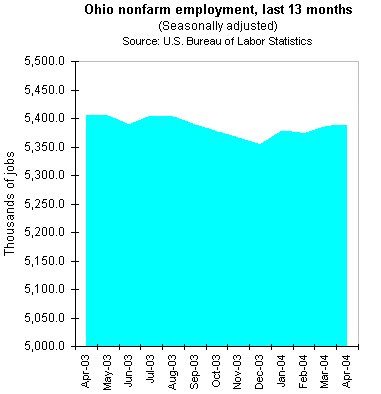
NEW OHIO JOB NUMBERS... THE NON-RECOVERY CONTINUES: The Bureau of Labor Statistics posted its May employment numbers for states this morning.

Total nonfarm employment in Ohio in May (seasonally adjusted) was 5,385,600, compared to 5,384,500 in April and 5,385,200 in March. (The April employment figure is significantly lower than originally reported... see below.) That's just four hundred new Ohio jobs in the last two months... during which the national economy supposedly added over half a million.

The May figure is 19,000 jobs below May 2003.

Remember the supposed revival of manufacturing? In Ohio: 827,900 manufacturing jobs in May, compared to 828,800 in April and 828,900 in March.

Easy come, easy go: Last month the BLS reported (on a preliminary basis, as always) a gain of 4,300 nonfarm jobs in Ohio between March and April. This was widely interpreted as evidence that the recovery was finally reaching us.

This month, BLS has revised its April figure downward by 5,000, which means the state actually lost 700 jobs between March and April.
SHARI WEIR IN CRAIN'S ON THE FIRST ENERGY RATE CASE:
In the current case... the PUCO gave First Energy, conditionally, an additional $2 billion in exchange for nothing at all...

What if Gov. Bob Taft said his second-term economic plan was to pull $1 billion out of the northern Ohio economy in each of 2006, 2007, and 2008?

That's what Taft's appointee Mr. Schriber and a majority of the PUCO just decided to let First Energy do. The "Third Frontier" turns out to be our pockets.
Ohio Citizen Action has the whole Crain's op-ed posted on its website.

6.17.2004

WASTE OF BANDWIDTH: Well, it's one week later. The Cleveland School District budget cuts, teacher and other layoffs, slashing of bus transportation, slashing of bilingual staff, etc. etc. are now final as of the School Board meeting Tuesday evening.

But there's still not a word about it on the School District web site... or on the Mayor's web site, either.

Should we conclude, charitably, that the District's PR office has been cut back and there's no one left to post press releases? But no, here's one posted on Monday. All about an administrator you never heard of who got a better job in Minneapolis, and how elated Barbara Byrd-Bennett is for her -- with five, count'em, five media relations staff listed as press contacts.

And here's another one, also posted Monday: "Six Students To Attend Camp Focus".
CLEVELAND, OH – Team Focus announced this week that four Cleveland Municipal School District students would attend Camp Focus Michigan on the campus of Concordia University in Ann Arbor, June 28th through July 2nd.

Additionally, two more students will attend the national camp in Mobile, Alabama, July 11th through 15th. Expenses are being paid by the national Team Focus organization.
With that kind of breaking news to handle, I guess you can understand why the District's five media relations professionals and its crack website staff haven't gotten around to the small stuff -- like the School Board amputating teaching staff and bus routes.

Geez, what a waste of bandwidth. Hey, I know where they can save some money...

6.09.2004

SCHOOL BUDGET CRISIS INVISIBLE ON SCHOOL, CITY WEBSITES: Last evening at a School Board meeting at Garrett Morgan, the Cleveland Municipal School District administration announced its second big round of budget cuts for the coming school year, including hundreds of additional teacher layoffs. Everyone from CEO Byrd-Bennett to the teachers union to the press to -- well, everyone -- agrees that this budget-cutting process is an historic crisis for the schools. Everyone knows it's the prelude to a big tax levy this November. Locally, this is the most important public issue of 2004.

Here's the School District's "News and Information" webpage, with current news releases. And here's the news release archive.

Please note that there is still not one document with information about the budget crisis, cuts, or levy posted.

Mayor Campbell is the only elected official with responsibility for the operations of the CMSD. Here is Mayor Campbell's archive of press releases, current through today. Please note that here, too, there's not one document posted with information about the budget crisis, cuts, or levy.

I guess Cleveland citizens are supposed to get our information about our public school system from Channel 19.

6.05.2004

A FERRY GOOD IDEA MOVES FORWARD: The Port Authority Board took delivery yesterday of its long-awaited feasibility study on Cleveland-to-Ontario ferry service. Bottom line: The market seems to be there for tourists and trucking; the economics look workable; let's move forward to bids from potential operators.

The PD's front page story is here:
A Cleveland-Canada ferry could shove off in two years - a ship that could carry more than 800 passengers and 400 cars and include restaurants, bars, shops and cabins to take a nap.

But no gambling, said Rose Ann DeLeon, director of strategic development for the Cleve- land-Cuyahoga County Port Authority.

A $400,000 port authority study recommended a one-way fare between $45 and $55 per person, according to season, and between $25 and $40 for a cabin. The cost of a car would be an extra $50 to $60.

Cost would be about $100 for a tractor-trailer, including the driver's fare, and between $100 and $120 for an RV, but does not include the driver's fare.

The trip would take between four and 4½ hours.
The full 87-page TranSystems study is already posted at the Port's website here.

TranSystem's proposed $45-55 fares are comparable to other trans-lake ferries, but the projected travel time is significantly slower. The new Milwaukee-Muskegon "Lake Express", for example, covers a similar 90+ miles across Lake Michigan in two and a half hours, at $50 per passenger. The difference probably stems from TranSystem's proposal to combine passenger/car and truck service in one vessel, which seems like a good idea to me. But if the trip is going to take over four hours to Port Stanley, it probably needs to be cheaper -- which isn't a bad idea anyway, if the Port wants its ferry to become a routine transportation mode, not just a tourist attraction.

Stay tuned, this is getting interesting.

P.S. Who brought up gambling?

6.02.2004

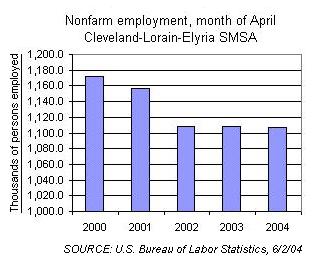
RECOVERY STILL JOBLESS: The Bureau of Labor Statistics monthly employment numbers for metro areas are out today. Nonfarm employment for the Cleveland-Lorain-Elyria metro area was 1,107,200 in April, up about 6,000 jobs compared to March. But these are "non-seasonally-adjusted" numbers -- meaning that they don't take into account the fact that employment always ticks up in April compared to March. Compared to April 2003, the April 2004 job count is down by about 800.

Bottom line: Cleveland metro-area employment is essentially unchanged from a year ago. And from two years ago, for that matter.

5.31.2004

CHASING WAL-MART PART 2, PART 2: Here's an article from the Sun-Times on Wednesday that lays out the sides in the Chicago City Council fight pretty clearly.
The Chicago Federation of Labor has made three demands of the retailing behemoth it calls "Public Enemy No. 1": that Wal-Mart agree not to sell groceries at any of its Chicago stores to avoid driving down the wages of its supermarket competitors, that the company remain neutral in any union-organizing campaign and that it pay its Chicago employees a "living wage."

None of those promises are included in the letter, and Wal-Mart made no apologies for the omission.

Asked why Wal-Mart won't pay the living wage of around $9.10 an hour when its Chicago area associates already average $10.77 an hour, regional manager for community affairs John Bisio said, "Wal-Mart is not a city contractor. Nobody that I know in retailing is promising to participate in something that doesn't apply to them."

Chicago Federation of Labor President Dennis Gannon charged that 60 percent of Wal-Mart's employees are part-timers earning only $7.55 an hour.

"If this marketplace means so much to Wal-Mart, what's the problem putting it in writing for all the world to see?"

While initial plans call for the Wal-Mart stores in the Chatham and Austin neighborhoods to sell general merchandise only, Bisio said a super-center that sells groceries cannot be ruled out.
And another take from the Tribune, via the Joe Hill Dispatch (the Tribune site requires registration):
We have leverage here," said James Thindwa, executive director of Chicago Jobs With Justice. "They cannot maintain their level of profitability without going into urban centers like Chicago. This city has an opportunity to set a precedent, to really shift the terms of debate on Wal-Mart."

For some, that has already happened. Community leaders in the West Side's Austin neighborhood who support Wal-Mart's arrival to a commercial landscape dotted with dollar stores, fast-food restaurants and corner grocery markets have garnered a string of promises from the company, some of them unprecedented, Bisio said.

For example, area churches and other groups would have a say about which banks handle daily deposits for the store and which contractors would help build the store at Kilpatrick and Grand Avenues, Bisio said. The company has also said at least 75 percent of the 300 jobs created at the store will go to people from the community, including the possibility of hiring ex-convicts; it will pay "competitive wages" that start at $7 an hour; and it will consult local leaders on where corporate donations would be most useful.

Wal-Mart executives are in similar discussions with groups in the Chatham neighborhood on the South Side, Bisio said.

"We've weighed the pros and cons of having a Wal-Mart in this community and the pros far outweigh the cons," said Rev. Joseph Kyles, chairman of the 37th Ward Pastors Alliance, a group of 24 area churches on the West Side. He characterized the various commitments as opportunities to address such long-standing local concerns as bank redlining, affordable housing and deteriorating public schools.
More here and here.

5.30.2004

CHASING WAL-MART PART 2 -- WHAT WE CAN LOOK FORWARD TO:

There are lots of stories today about Chicago City Council voting to approve one new "neighborhood Wal-Mart" but not a second. Here's the AP story from the South Bend Tribune...
Last month, Wal-Mart launched a lobbying campaign to overcome the opposition. The retailer used a telephone bank to connect people who said they supported the stores directly to several aldermen's ward offices.

The supporters were found by pollsters hired by Wal-Mart, who called hundreds of Chicago residents Monday and Tuesday. Anyone who said they supported the stores was patched through to one of 11 aldermen, according to Thom Serafin, a public relations consultant hired by the retailer.

5.29.2004

WHY AREN'T WE FEELING BETTER YET?

MaxSpeak sez: "Economic growth is great, unless you have to work for a living."

From the Economic Policy Institute article he's pointing to:
Corporate profits have risen 62.2% since the peak, compared to average growth of 13.9% at the same point in the last eight recoveries that have lasted as long as the current one. This is the fastest rate of profit growth in a recovery since World War II.

Total labor compensation has also turned in a historic performance: growing only 2.8%, the slowest growth in any recovery since World War II and well under the historical average of 9.9%.

...Growth in total wage and salary income, the primary source of take-home pay for workers, has actually been negative for private-sector workers: -0.6%, versus the 7.2% gain that is the average increase in private wage and salary income at this point in a recovery.

These are ominous signs, suggesting a new march toward greater inequality in the American economy. Worse, the growth in profits combined with a drop in wage and salary incomes suggest that the recovery has a narrow base, with most American consumers only able to increase their purchasing power through debt. Wage growth is not just fair, it is also necessary for a more sustainable recovery.

5.28.2004

CHASING WAL-MART: Via Ed Morrison via Brewed Fresh Daily, we learn that Good Jobs First has a new report out documenting a billion dollars in government subsidies to Wal-Mart. This will not be surprising to those who follow Policy Matters Ohio, which published this two years ago.

But in the light of the Campbell Administration's ongoing pursuit of big box stores for city locations -- and the rumors I keep hearing that the city has been talking to Wal-Mart -- this new report does bring up an interesting question:

Exactly what economic development goal would it serve for the city to subsidize the location of one or more Wal-Marts (or Targets, which run their business pretty much the same way) in Cleveland?

If the goal of economic development is to spur local "wealth creation", Wal-Marts would seem to be a negative. The chain displaces local retailers, has no significant local ownership, exports its profits to Arkansas or somewhere like that, buys no products locally, is actively anti-union and pays crappy wages.

If the goal of economic development is "job creation", city Wal-Marts (or Targets) will make little or no net difference. Their suburban stores already hire city residents, and new stores are likely to simply displace other retailers and move existing jobs around (in some cases from better-paying unionized stores, which was the root of the recent California grocery strike).

I know, I know, the idea is to recapture city residents' retail dollars that are now flowing to the suburbs. Get a big, irresistible magnet store in a Cleveland location and other stores will cluster around it (including maybe some small locals) and create a newly viable retail district. But this just begs the main question. If most of the spending in the new retail cluster goes to a multinational company that sends its profits out of town, and pays lousy wages while displacing other local job opportunities -- and turns the neighborhood into a never-ending traffic jam -- who is "capturing" whom?

So why even think about chasing and subsidizing this kind of business in city locations? Who -- except for some real estate developers and maybe a couple of trash haulers and landscaping companies -- stands to gain?

With all the talk about smarter economic development, it would be nice if somebody -- maybe one of her foundation travel funders -- would ask Mayor Campbell this question before she boards the plane to another retailers' convention.

5.26.2004

IS MANUFACTURING COOL NOW? All of a sudden, the "M" word is on the lips of Cleveland's talking heads. And now "The Quiet Crisis: Manufacturing" makes it official -- we still care about companies that make actual physical objects in northeast Ohio factories!

As you probably know, Joe Frolik's newest TQC panel airs tomorrow night on Channel 25 and runs in the Plain Dealer Sunday. But you can get a jump on the official release by reading the entire, somewhat ragged transcript here.

It's not a bad session as TQC panels go. The panelists are mostly in the business -- Bill Brake of ISG, Jack Schron of Jergens and Scott Rickert of Nanofilm are particularly interesting -- but there's also Weatherhead prof Sue Helper raising some big-picture issues not typical for TQC. (Like... if we have all these productivity improvements, maybe we could have shorter work weeks instead of fewer jobs?)

My favorite quote, from ISG's Bill Brake:
We're very proud of our partnership with the United Steel Workers of America... What a region can offer for us is an employee that's more sophisticated than a high school graduate of 20 years ago that comes into a large manufacturer and works on an assembly line or works in the mill.

A key component of our success at ISG has been the ownership, and accountability and responsibility of the hourly worker and they have truly taking an ownership of it. In order to make that successful, they have to be aware of business basics. They have to understand the costs. We explain EBIDTA to them to make sure we all understand what our key metric is for us. We share sales prices, we share costs of materials, things that weren't done as recently as five years ago. To explain to a worker, do you know that roll costs us X thousands to get refurbished, is that the right decision to make and let that individual make the decision. To have that successful, I need a sophisticated worker that cares about his business.
Hey, here's an innovative, outside-the-box thought: How about somebody from that Steelworkers local in the discussion? Or from the UAW local that sold Ford on reinvesting in the Brook Park engine plant? Or anybody at all from a union?

But there's an even worse sin of omission. Why, why, why isn't John Colm of WIRE-Net on this panel? Apparently he's in a supplementary interview, but when the "experts" are lined up, once again he's not there.

If you don't know WIRE-Net, do me this favor: Look through their website, consider that John has worked for fifteen years to build this nationally recognized operation from the ground up... and then ask yourself what it takes to get listened to in this town.

5.23.2004

PD DOES A GOOD JOB ON JOBS TODAY: Alison Grant's long article on Ohio employment in this morning's Plain Dealer ("Want answers on jobs? Study patterns, not rhetoric") is several cuts above the paper's norm. Grant (along with her editor) deserves a lot of credit for a thorough, careful, ambitious piece on a really difficult subject.

How many local reporters, for example, try to explain to general readers how Ohio's manufacturing workforce is shrinking partly because our workers are so productive? And omigosh -- the story actually reveals that
...new claims for unemployment insurance [show] the state still flashing a recessionary signal. Ohio had more than 12,000 new claims during the first week of May. A more normal figure for this time of year would be about 7,000.
... a fact that George Zeller of CEOGC has been trying to get into the PD for months.

If the PD's going to make "Ohio jobs and the election" an ongoing beat, I'm rooting for Grant to get the assignment.

...AND THERE'S MORE: Steve Talbott writes that "Education may be the impetus for innovation we need"...
If the future is about no longer depending on the Big Three for our economic well-being but, rather, relying on the ingenuity of our highly educated work force, Ohio is not making the grade. We need to become innovators again.

Perhaps even more astonishing, two-year community and technical colleges accounted for just 47 percent of the state's postsecondary enrollment - compared to a 60 percent average nationally. Two-year schools are powerhouses of opportunity for kids coming out of high school and for workers who need to retrain. But even though we need them more, we're using them less.

The good news is that the goal is within our grasp. All we need to do is become obsessive about education, college education.
Yes! Send Cleveland to college!

5.21.2004

OHIO GAINED JUST 4,300 NONFARM JOBS IN MARCH... leaving the state down 16,500 jobs compared to a year ago.

The U.S. Labor Department released state-by-state April employment statistics this morning. Ohio's nonfarm employment: 5,389,500 jobs in April compared to 5,385,200 in March, 5,373,500 in January, and 5,406,000 in April 2003.

The count of unemployed Ohioans also rose by about 5,000 from March to April.


Cleveland metropolitan area numbers are due for release June 2.

5.20.2004

LIFE IN THESE OLD-ECONOMY BONES YET: You probably know that International Steel Group completed its acquisition of Weirton Steel on Tuesday. And if you drive in that general vicinity, you've probably noticed that the West Side ISG mill is back in production.

But have you picked up on the fact that Cleveland's ISG is now the nation's biggest integrated steel company?
With the acquisition completed, Richfield, Ohio-based ISG has moved up from the No. 2 integrated steel maker in the country to No. 1, surpassing Pittsburgh's United States Steel Corp., when measured by domestic production capacity.

Cleveland, Ohio... Steel Capital USA.
SHIPPING NEWS: From www.boatnerd.com (officially the DAILY GREAT LAKES and SEAWAY SHIPPING NEWS):

Another cross-lake fast ferry on the Great Lakes...
5/20

The fast ferry Lake Express arrived at Milwaukee's breakwall shortly after 3:30 Tuesday. On hand to greet the ferry were assorted tugs, including the G-tug Virginia, pleasure craft and government vessels. The Lake Express made a short tour of the outer harbor off downtown Milwaukee and then proceeded to the Port of Milwaukee's Heavy Lift dock.

With the new ferry dock not quite finished, the Lake Express will use the Heavy Lift dock as a base of operations for additional crew training. Trips on Lake Michigan are also planned and a trip to Muskegon is expected as well.

(The new privately owned ferry, built in Alabama for $18.5 million, will carry 250 people and 45 cars on the Milwaukee-Muskegon run across Lake Michigan three times daily. The distance is similar to the proposed Cleveland-to Port Stanley route. For more see the operator's page here.)

And...
Lightning Strikes Tall Ship Denis Sullivan

05/19

The Tall Ship Denis Sullivan, enroute to Milwaukee, Wis., from Erie, Penn., was struck by lightning Tuesday night in a storm north of Mentor, Ohio. While none of the crew was harmed, the electronic systems failed making it difficult to navigate. Fortunately, one of the mates had a hand-held GPS and managed to make it to Cleveland's North Coast Harbor.

S.S. William G. Mather Museum operations manager and live-in ship keeper, Bill McDonald, offered assistance when he discovered his new neighbor moored next to him at the end of East Ninth Street Pier. The Sullivan crew was appreciative of Cleveland hospitality, including hot showers and cold beverages.

The Sullivan last visited Cleveland during 2003's Tall Ships Harborfest. The S/V Denis Sullivan is Wisconsin's Floating Classroom and Ambassador Flagship. Some proponents of Cleveland's lakefront development suggest that Cleveland might also benefit from a similar tall ship vessel with Cleveland's North Coast Harbor as her home port.

While taking a tour of the Mather Museum Tuesday afternoon, the crew of the Sullivan said they would know within the next few hours if they have sufficient repairs to resume their journey. With thunderstorms anticipated through the rest of the week, they do not want lightning to strike twice.

5.19.2004

THE "RE-SEGREGATION" OF CLEVELAND PUBLIC SCHOOLS? Sunday's PD spread ("66% of Cleveland's minorities attend racially isolated schools") and Roger Jones' column in the current Free Times both draw attention to the same sorry fact: Fifty years after Brown v. Board, and twenty-five years after Reed v. Rhodes, most black kids in Cleveland are going to overwhelmingly black schools. (A lot of Hispanic kids are going to majority-Hispanic schools, too, but that's a different issue with a different history.)

Is this the "re-segregation" of the Cleveland schools? Well, on one level, of course it is. If you go through the 2003 enrollment statistics for all 86 Cleveland Municipal School District ("CMSD") buildings with students in grades K-5 (they're here), you find that 46 of those buildings had student bodies that were more than 90% black. These kids were undeniably isolated from their peers of other races. (Speaking of "isolated", the average number of white students in these buildings was five.)

Most white CMSD students, on the other hand, go to schools that are "integrated" by any usual standard. Only one grade K-5 school was more than 75% white in 2003... William Cullen Bryant in Old Brooklyn, whose students were 86% white, 6% black and 9% Hispanic. Six other schools -- three in Old Brooklyn, three in West Park -- had white enrollments above 60%, with black and Hispanic students filling out their rosters in roughly equal numbers. These seven "mostly white" schools accounted for about a third of all the white kids enrolled in the CMSD's K-5 and K-8 buildings. The other two-thirds went to schools where 40-80% of their classmates were "students of color".

How can the Cleveland schools be segregated for most black kids but integrated for most white kids who go there? The answer, of course, is that there aren't enough white kids to go around... and there are large parts of the city where none of them live.

The CMSD's overall student demographics in 2003 were...
Black students -- 50,480 (70.6%)
White students -- 13,209 (18.4%)
Hispanic students -- 6,528 (9.1%)

... with "others" at less than 2%. So if you took all the white and Hispanic kids and distributed them evenly thoughout the city, all the black kids would still be going to mostly-black schools.

Why so few white kids? It's not mainly because of private school competition... the 2000 Census showed a higher percentage of whites enrolled in K-12 private schools than blacks or Hispanics, but two-thirds of the city's white kids were still in public school. If all the private-school students in Cleveland, of all ethnic backgrounds, rejoined the CMSD tomorrow, black kids would still be 65% of the system's customers, and whites would barely exceed 25%.

The simple fact is that Cleveland has become a "city of color", especially among its younger citizens. White Cleveland residents are now just the city's biggest racial minority. And pretty much all the city's families with school-age kids, of any race, are poor.

In this environment, do "segregation" and "integration" have any meaning in Cleveland 2004? Maybe it's time for a new paradigm.

Or maybe it's the same old paradigm in a new setting. Maybe Cleveland needs to insist on putting a unified city/suburban school system at the top of the "regionalism" agenda.

5.18.2004

IF YOU MISSED PLUG IN CLEVELAND (or even if you were there), Dan Hanson has posted a complete account with pictures at the Magnum Computers website.

IT AIN'T FLASHY BUT IT'S GOT CONTENT: Cleveland City Council is now posting the full, official City Record on its website each week... with a complete archive all the way back through 1996! (Also posted... the Mayor's proposed 2004 budget.)

5.16.2004

ELECTABILITY: A few Sundays ago, Brent Larkin wrote a Forum column about Mayor Campbell's election prospects. It was mostly old news, except for the parts that were somebody's weird wet dreams (e.g. the return of Mike White, but only the 1990-95 version). Predictably, Larkin prescribed an unnamed "big idea" to salvage the Mayor's ratings. When life was simpler, this used to mean the convention center, but now it's probably downtown gambling. (Apparently tearing up a major highway and cutting the port in half to build houses and parks all over the lakefront isn't "big" enough.) Yada yada....

Anyway, I was more interested in the Mayor's own analysis as quoted through the column:
Campbell knows she has disappointed many. Her take on why is essentially this:

She became mayor as the economy tanked and tax receipts went south...

"Now what do we have?" she asks. "We have a decrease in income tax receipts, a state government that is completely uninterested in cities and a federal government that has walked away from investing in them. So now people are mad cause the mayor can't deliver.

"If I had money, everybody would love me. But the city has no money, and all the things people want cost money... I think anybody who would be mayor at this point in its history would be challenged to produce."...

"You always worry about an election," she said. "There's two ways to run - unopposed and scared. In 19 months I have to produce investments in safety, in housing, in making this an economically viable community. The more successful I am along these lines, the more electable I will become."
Whiny as it may sound, the first part of this analysis is essentially accurate. Republican administrations in Washington and Columbus, combined with a tanked national economy, are the proximate causes of the City's fiscal and economic emergencies. It is a near-impossible task to balance the books, keep the trash trucks rolling and keep your friends happy in this situation. (Just for fun, let's imagine how Mayor Raymond Pierce would be doing at this point in his administration.)

And the problem for the city goes way beyond fiscal difficulties. Every dollar of lost wage tax signifies fifty dollars of lost personal income for some taxpayer. Cleveland has thirty-some-thousand citizens looking for work, not to mention those who've given up looking. We've got homes going into foreclosure at a record rate. We've got gas and electric bills going unpaid, cars being repossessed, hard-working people going bankrupt. Cuts in city services (like glass all over the playground and no staffed summer program where your kid used to play) are just insults added to these injuries.

So the Democratic Mayor has every right to point the finger at Republican Washington and Columbus, at budget cuts and economic mismanagement, as the source of Cleveland's (and her) immediate woes. But the next question is: What's she gonna do about it? And the answer seems to be: Not much.
In 19 months I have to produce investments in safety, in housing, in making this an economically viable community. The more successful I am along these lines, the more electable I will become.
No. Wrong answer. "Producing investments" will do little to make the Mayor more electable, because "investments" are not what the voters (or the business guys, for that matter) are looking for. What we're looking for is results -- actual jobs that we can get, actual peace and safety on our streets, actual tenants to rent our vacant offices, actual recreation staff and cleanup crews down at the playground. And because of the external obstacles the Mayor has correctly pointed out, she's not likely to produce enough of those actual results between now and Summer 2005 to make us believe things have turned around. (Sorry, but visions of new neighborhoods and parks on the water, which might seem like nice ideas in better times, become gratingly irrelevant when you've just filled out your 90th job application at the nursing home or Dollar Store.)

But there's one thing the Mayor can do to make herself more electable in 2005... something that speaks directly to the national environment that's causing us so much pain:

Campbell could make it her first priority to help produce a massive voter turnout in Cleveland this November.

By "massive" I mean 190,000 or 200,000 votes, compared to the 136,000 that voted here in 2000. That kind of turnout would go a long way toward delivering Ohio's electoral votes to John Kerry, which could, in turn, put him in the White House. If that were to happen, and Jane Campbell played a significant role in making it happen, her "electability" factor would improve dramatically. Why throw out an incumbent who's the new President's good friend?

As a side benefit, a really big turnout might also help pass the school levy, whose failure will cause major damage to her remaining base of support.

There are already serious players -- not all of whom are Campbell's friends -- in local voter registration and voter turnout efforts, and lots of national resources, so it would be wrong to suggest that there's a vacuum for the Mayor to fill. But a sitting Mayor has opportunities to do things and mobilize resources that others can't -- money, people, free media. Campbell should be asking herself if it would be smarter to start targeting those resources toward winning a friend in the White House... rather than, say, toward bailing out the Sports Commission's grandiose plan for the International Children's Games.

Win or lose the Presidential race, the Mayor's re-election will still hinge on convincing stressed-out city residents that she's actually doing something that matters to our lives. I don't know if that's still possible. But it would be a lot easier with the support of President John Kerry.

Just a thought from the bleachers.

5.13.2004

5.10.2004

MORE SHAMELESS PROMOTION DEPT: Plug In Cleveland 1.0 is coming this Wednesday.

If you still don't know what Plug In Cleveland is, click here.

If you want to get your ticket on line, click here.

If you want to see a picture of special guest Jiffy the Robot, click here.

BLOGGER PROBLEM: Blogger went live with a "new, improved" system Sunday evening. Naturally, what it's giving me so far is a new problem: it now insists on displaying the entries on this main page from earliest to latest, putting the newest entries at the bottom of the page.

I don't see any way to fix it in the settings. So... for the time being I'm telling Blogger to show only one day of postings here. For anything earlier you'll have to look at the archives (which don't have the same problem.)

I know this looks strange, but I'm sure it's temporary.

5.06.2004

WHY WE CAN"T KEEP ANYTHING STRAIGHT DEPT: The PD headline this morning reads "Cleveland's high-tech center is $3.5 million over budget". The lead paragraph says:

Mayor Jane Campbell's administration badly underestimated the cost of a new high-tech center for city computers and needs an extra $3.5 million for the project.

But when you read the rest of the story, it turns out that a) the "underestimate" of costs on the original project is actually $1.7 million (which is plenty bad enough); b) the rest of the "extra $3.5 million" is not an overrun but a proposal to expand the project by adding facilities for the separately funded Water Department and the Municipal Court, at their cost; and c) the money that the Mayor wants Council to approve is from Homeland Security grant funds and Water and Court funds, with construction bond money as backup -- no General Fund money is at issue.

Now this is all in Mike Tobin's article, which is quite straightforward and even-handed once you get past the lead. And the core story -- estimating screwups and strategy changes in the tech center project -- is certainly legitimate news. A $1.7 million, 50% cost overrun is serious business. I'd love to know more about the hows and whys: Did they get a bad work estimate from the architect? Does the building have structural or environmental problems that somebody missed? Is the contractor market less soft than they expected? Did someone just do the math wrong? Is there some other backstory we haven't heard about?

And while we're asking questions, why did it take the Water Department and Court this long to decide to join up? Has this whole project been pushed too fast because of the International Children's Games?

The article doesn't address any of these questions, so we don't know if there's more to this than meets the eye. But here's what we do know:

A $1.7 million shortage in the project budget is not the same as a $3.5 million shortage. Which makes the PD's headline false, and the lead sentence very misleading.

"Give light, and the people will find their own way." Oh, I'm sorry, that was that other newspaper.

4.29.2004

DO THE JOB STATISTICS MISS ENTREPRENEURS? George's permalinks still aren't permalinking, so you'll have to go to the top of BFD and scroll down a few entries to "Callahan by the numbers" to see Anita Campbell's comment about my last post and my reply to it.

It would be nice to get a comment or two here... but heck, I'll take what I can get.